
Vulnerability
The condition of being human.

The Friend
A friend wrote to me after surgery and said, “I’m in the recuperation phase. I’m feeling vulnerable.” The word stopped me.
After surgery, vulnerability is literal. The body has been opened, the boundary between inside and outside has been crossed. Movement is slower, noise is sharper, one is aware of being permeable.
Vulnerability seems ubiquitous these days. This is not weakness; it is exposure. It is what happens when the armor that protects our narratives, physical, emotional, professional, political, is lowered or pierced.
Humans, by definition, are vulnerable creatures. Death demonstrates that in the clearest terms. And yet in this postmodern world, we have fallen in love with the fantasy of invincibility.
We curate strength, we market certainty, we speak in absolutes. But exposure is the deeper truth. As Toni Morrison wrote, “Definitions belong to the definers, not the defined.” Invincibility is often a definition imposed from above, a story told about what we should be.
Vulnerability is most about what we actually are.
Vulnerability is not fragility. It is the condition of being mortal, relational, dependent, and interwoven. It is what makes compassion possible. The question is not whether we are vulnerable.
The question is what we do when the armor falls away.
And all of this brings to mind a myth.
Ariadne
Ariadne, a princess by birth, gives handsome Theseus the thread that saves him from certain death in the labyrinth in exchange for escape from her father. She risks everything in the process. Then she wakes alone on the shore of Naxos, abandoned.
That is relational vulnerability. The exposure that follows trust, the sudden absence of the one who promised protection. There is no defense, no narrative left intact.
Rebecca
In medicine, I saw vulnerability take other forms.
Rebecca was fifteen when her kidneys failed. Her mother was undocumented, intelligent, fiercely protective, armor was thick because it had to be. But dialysis has a way of stripping armor in patient and family alike.
Dialysis is procedural vulnerability. Two large needles inserted into a teenage arm three times a week, blood leaving the body, circulating through a machine, returning altered. The body exposed to tubing, filters, alarms. The family exposed to time, repetition, uncertainty.
They trusted the process and that trust itself was vulnerability.
Then came transplant.
Transplant is hopeful vulnerability. It is agreeing to surgery, to immunosuppression, to risk, because one believes there may be relief on the other side. It requires the patient and family to place themselves again in the hands of a system. It requires faith in something not guaranteed.
When rejection appeared, vulnerability changed shape again. It became existential vulnerability.
Then came the late-night emergency visits with fevers, shortness of breath, laboratory values drifting away from normal. Each visit was an exposure, not only of the body, but of expectation.
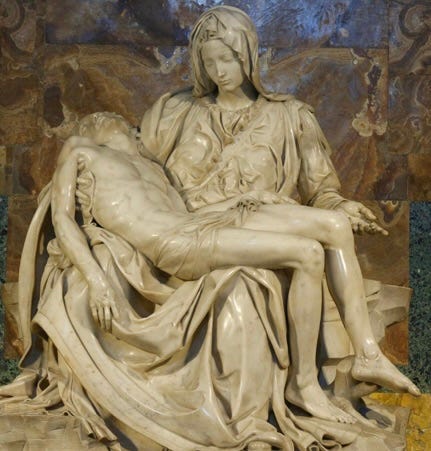
The final day of Rebecca’s life distilled vulnerability to its most elemental form. Her mother called: Rebecca was short of breath and I directed them to the hospital. We met them at the door and the surgeon carried her in his arms. Rebecca was gasping, near comatose. The body that had endured needles and surgery and medications could no longer compensate. There was no additional procedure to offer, no dialysis access left, no escalation possible. Years later, when I saw Michelangelo’s Pietà, I recognized the posture immediately, a body held when there is nothing left to repair.
This was mortal vulnerability. The exposure of a body that can no longer sustain itself.
Her mother stood there without armor, not because she was weak, but because there was nothing left to protect against. I stood there knowing the same thing. The surgeon knew it too. She died in front of us.
We were all exposed to the same truth.
Vulnerability, in its final form, is the recognition that control has limits.
Us
There are kinds of vulnerability that ask for intervention, a surgery, a medication, a machine. And there are kinds that ask only for presence.
In our cultural moment, vulnerability is often mocked or attacked. With immigrants, survivors of sexual abuse, dark skinned citizens, transgender individuals, and women in general “Otherness” is targeted precisely at the point of exposure.
But vulnerability is not a defect in a person or a system. It is the condition of being human.
Surgical vulnerability.
Relational vulnerability.
Procedural vulnerability.
Hopeful vulnerability.
Existential vulnerability.
Mortal vulnerability.
Each requires something different from us. The last requires that we do not leave.
When there is nothing else to be done, vulnerability remains.
And the only ethical response left is to bear witness.
To each other.
Over and over.
This is so beautiful! Thank you so much for your insights...I read them every day, & I appreciate them so much.
Keith- Your insight and comments continue to fuel me in this exploration. If one person sees the patterns I am describing, it all has been worthwhile. But/and, the consciousness exploration is at an end. Monday I will summarize "Cerulean Consciousness", but with the Kansas transgender drivers license assault, I felt that I need to get more granular and will head into a twice weekly discussion of: "Experience, Strength and Hope" and what that looks like with boots on the ground lived experience. As you have discovered in your teaching/coaching, people need grounding and affrimation at this point. I will be anxious to see how you feel about the new content. Blessings, Sheila